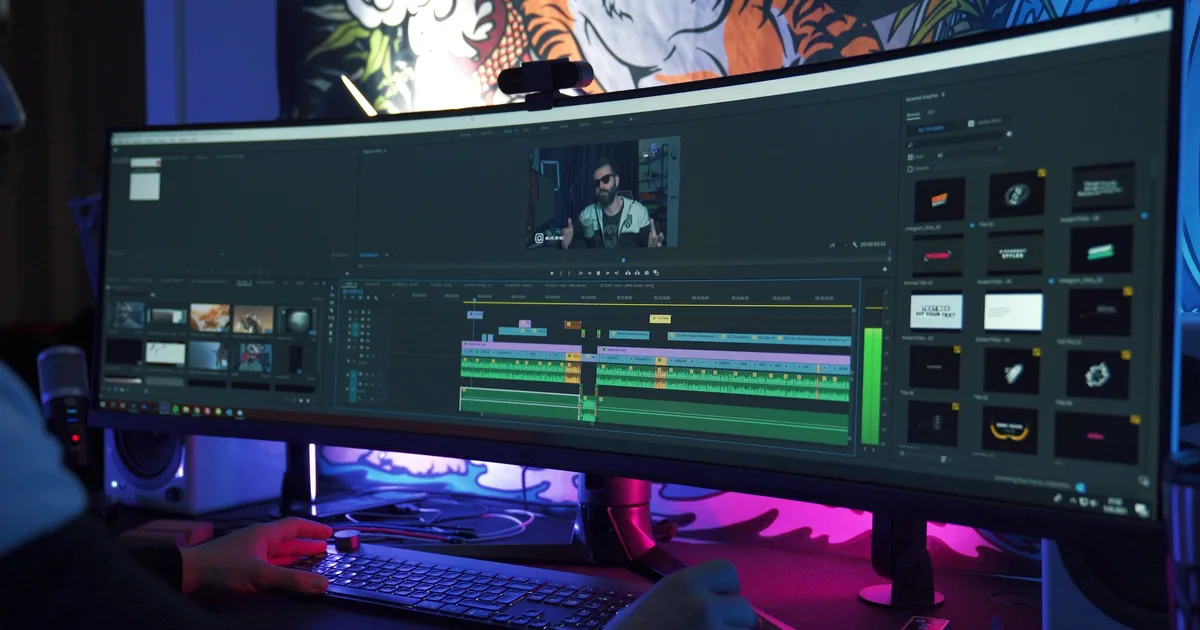
Logo and colors
Logo (and a separate one for dark backgrounds), primary and accent colors for buttons, links, and accents, and a custom icon in the browser tab.
White-label video hosting
White-label video hosting is when the client sees your name, not ours, from the first email to the last download. Logo, colors, and font on the delivery page, your domain in the address bar, and an access-code email in your name. The platform does the work; the brand is yours.
✓ 7-day free trial 5 GB included No credit card

Brand controls
Logo (and a separate one for dark backgrounds), primary and accent colors for buttons, links, and accents, and a custom icon in the browser tab.
The font for headings and text on client pages—matched to your brand.
From a simple list to a full-screen premiere. Each delivery page gets its own background, text, and button colors.
Delivery pages on films.yourstudio.com with automatic HTTPS—on Pro and higher.
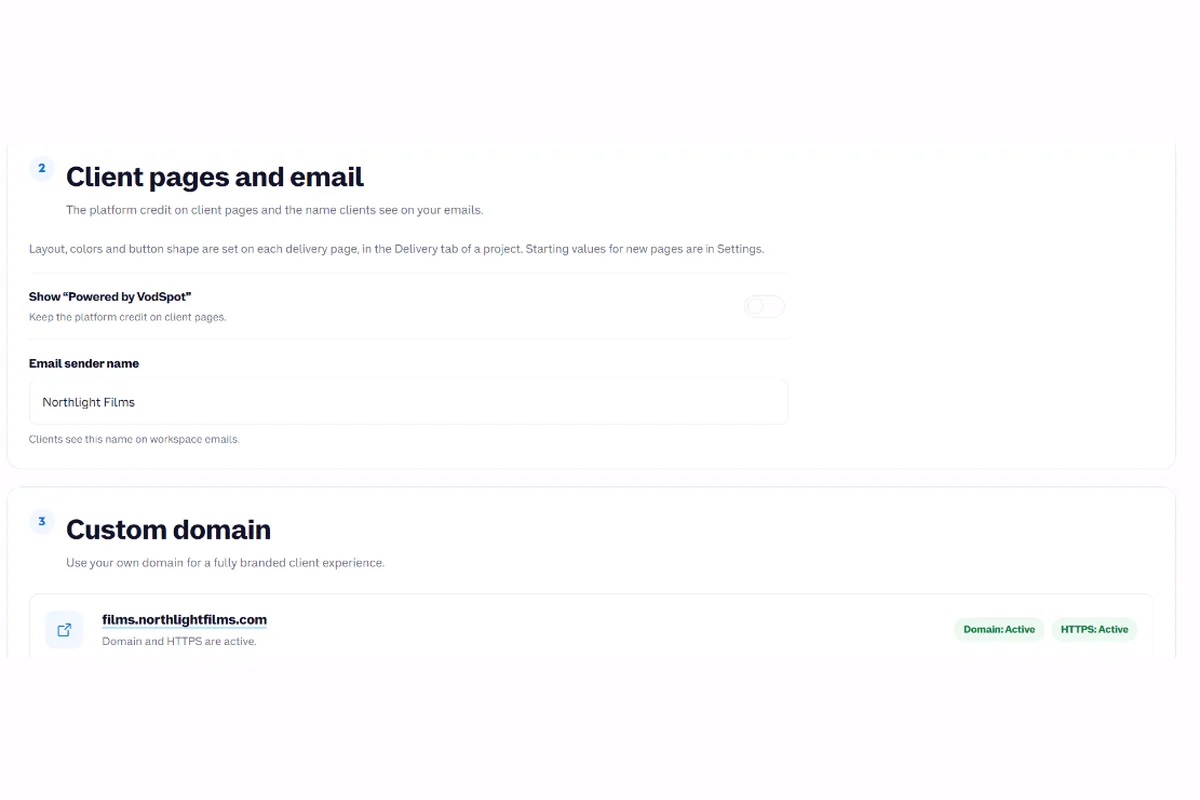
The access-code email comes from the sender name you set in your branding, with your logo in the header.
No third-party logos, no recommendations, no end screens next to your film. “Powered by VodSpot” can be removed on Pro and higher.
Custom domain
Clients move from your website and your emails to a delivery page on your own domain. Point a subdomain like films.yourstudio.com to VodSpot—we’ll verify that the domain is yours and issue the HTTPS certificate automatically.
From then on, every delivery and video link lives on your address. Only delivery pages, video pages, and embeds open on your domain—no links to the VodSpot website. Even error pages carry your name and logo, and the loading bar is in your color.
Why it matters
The final handoff is often the most viewed thing you send: the client watches it, forwards it to colleagues, and returns six months later. A file transfer page or a cloud folder puts someone else’s brand on that moment.
White-label video hosting keeps attention on your work and your name. And it immediately tells every new viewer who made the film—that’s how recommendations begin. What that can be worth in dollars is in our branded delivery ROI calculation.
Clients don’t remember the platform. They remember who made it look effortless.
White-label video hosting, explained
White-label video hosting is video hosting that the client doesn’t see: the pages, player, URL, and emails carry your brand, not the platform’s.
The term comes from retail: a “white label” is a product that the seller affixes their own brand to. In video, the concept is the same. The service does the work—storing, encoding, and distributing—and the client sees only you.
Imagine Carmen: she has a two-person studio in Miami, making videos for residential developers. The client forwards the video about a new tower to investors and brokers. Previously, it was a file transfer link: someone else’s address, a background ad for a file-sharing service, a “you’ve been sent a file” email from a service investors had never heard of.
Now Carmen has a page at films.carmenstudio.com, a readable link /d/brickell-tower-launch, and a QR code the developer prints in the brochure. The studio’s logo, its colors, a full-screen cover. Every investor who opens the video sees who made it.
You put your name in the credits. Why let someone else sign the delivery page?
Many services offer “branding”: your logo in the player or on the page. But a brand in the player isn’t yet white-label video hosting. Look at the address and the emails.
WeTransfer. On the Ultimate plan ($19 per month when billed annually), the pricing table lists “Custom WeTransfer page” and “Personalized WeTransfer emails.” The page is yours, but WeTransfer’s. The emails are yours, but WeTransfer’s. There’s no custom domain on the pricing page, and on the Free and Starter plans, there are ads in the background.
Frame.io. Branded links are available on the Pro plan, but the help page explicitly states: “An email will be sent by Frame.io directly.” There’s no mention of a custom domain.
Galleries for Photographers. Pixieset removes its branding and lets you connect your own domain on all paid plans. At Pic-Time, that starts with Professional ($21 per month when billed annually), and video there is capped at 30 GB. Good services for photos; video is an extra.
Vimeo. Player branding is available starting with the Standard plan. But as of 2026, Vimeo doesn’t allow companies on its plans for individuals: studios and agencies go on the Studio plan at $400 per month when billed annually. How Wistia and Vimeo compare on player branding is in our Wistia vs Vimeo comparison.
White-label video hosting at VodSpot covers the page, the player, the address, and the email. Logo, colors, and font come with every plan. Your own domain, readable links, and a hidden “Powered by” come with Pro at $590 per year. That’s $4,210 (87.7%) less than Vimeo Studio per year.
A logo in the corner is a sticker. Your own domain is an address.
The most white-label option of all is your own video website. No other branding at all. But the cost of this option isn’t just money.
You’ll need storage, adaptive streaming transcoding, a player, link protection, access control, bandwidth bills, and someone to fix it all on a Saturday night. We’ve covered this step-by-step—with architecture, cost, and a launch checklist—in the article how to build your own video website.
White-label video hosting is the middle ground: your brand and your domain, without your own infrastructure. If you ever need your own website, videos from VodSpot can be embedded there, with domain restrictions so the player doesn’t play on other sites.
Your own site is freedom. It’s also your own weekend on-call shift.
Trust in a page is formed before a person reads a single word. And it’s based on familiarity.
Rachna Dhamija, J. D. Tygar, and Marti Hearst from Harvard and Berkeley showed 22 participants 20 websites—real and fake—and asked them to distinguish them. Ninety percent of participants were fooled by good fakes, and 23% didn’t even look at the address bar: people judged by the page’s appearance (CHI 2006). Our conclusion isn’t about scammers, but about how trust works: people look for familiar cues—logos, colors, style.
The same thing applies to emails. Tom Jagatic and his colleagues from Indiana University sent students emails that looked like they were from friends: 72% responded. When the same email came from a stranger, the response rate was 16% (Communications of the ACM, 2007). A familiar name opens the door, an unfamiliar one leaves it closed.
And the design itself adds weight. In an experiment, David Robins and Jason Holmes showed the same text in two versions—one with and one without a design. The designed version was judged more credible in 19 out of 21 cases (Information Processing & Management, 2008).
This explains the simple logic of white-label video hosting: the client knows your name, your logo, and your website. When the delivery page, address, and email with the code look the same, they don’t have to guess who it’s from. A service with an unfamiliar name raises a question at the one moment there shouldn’t be any.
Familiar doesn’t need checking. That’s why familiar gets opened.
Simple names are easier to process—this has even been measured on the stock market. Adam Alter and Daniel Oppenheimer of Princeton showed that stocks of companies with easy-to-pronounce names outperformed stocks with difficult-to-pronounce names on their first day of trading (PNAS, 2006). The same goes for addresses: films.carmenstudio.com/d/brickell-tower-launch is readable and memorable, but forty random characters on someone else’s domain are not.
What to check in any service:
VodSpot covers every point. Your own domain, readable links, a hidden “Powered by,” and all five layouts are on Pro and higher. See pricing.
A platform should work like a good sound mixer: you hear everything and never see them.
FAQ
It’s when the pages and player that viewers see carry your brand, not the platform’s brand: your logo, colors, font, and, ideally, your domain.
Yes, that’s the whole point of white-label video hosting. Delivery pages use your logo, colors, and font, and on Pro and higher, they run on your domain, so the client doesn’t see the VodSpot address. You can also hide the “Powered by VodSpot” line there.
Your own domain is included on Pro and higher. Branding (logo, colors, font) is included on all plans. See pricing.
Each workspace has its own branding and domain. Agencies that deliver work under different brands have separate workspaces—see video hosting for agencies.
Yes. On Pro and above, give the page a link like /d/smith-wedding. It also works on your domain. Send it by email, WhatsApp, or print a QR code.
Yes. The VodSpot player does not display the platform logo, recommendations, or end screens—on all plans. The “Powered by VodSpot” line under the delivery page is hidden on Pro and above.
Yes, this is part of white-label video hosting on Pro and higher. Point a subdomain like films.yourstudio.com to VodSpot—we’ll verify the domain and issue an HTTPS certificate. After that, delivery pages, video links, and embeds work on your address.
Yes. The access-code email comes from the sender name you set in your branding, with your logo in the header, and the link in the email leads to your delivery page.
Guides
Video websites
Five ways to put video on a site you own — from self-hosting to a private video platform — with the architecture, costs and trade-offs of each.
Read the guideResearch & Insights
Nobody has measured branded delivery directly. But it rests on things that are measured—and one extra project every few years already pays for it.
Read the guidePrivate sharing
Wistia, Vimeo or YouTube? A fair head-to-head: prices, free plans, ads, lead capture, analytics, privacy and original downloads — plus who should pick which, and when you need none of them.
Read the guideMake it yours
Start with seven days and 5 GB. No credit card required.