Press premiere
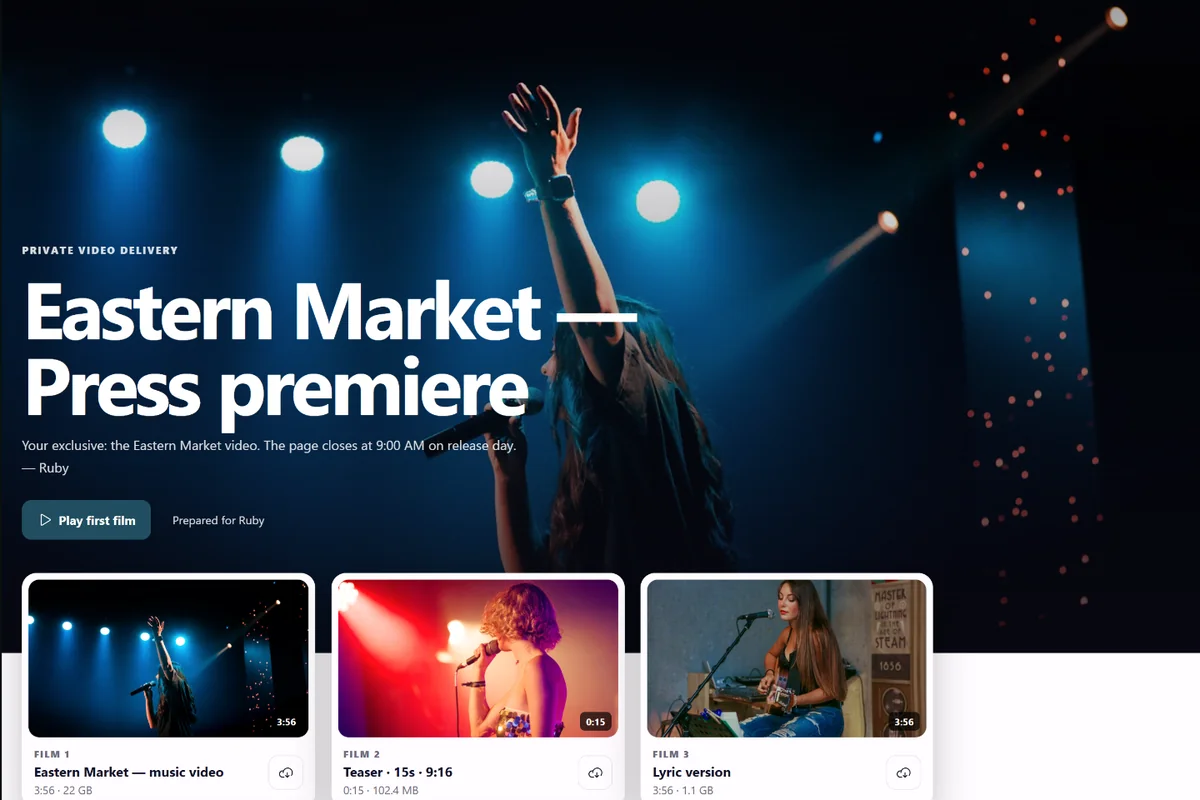
An exclusive for a blog or magazine: its own page, its own password, and an expiry on release morning.
Video hosting for musicians
Video hosting for musicians is a home for your video before release. The label signs off on the cut, a blog lines up an exclusive premiere, a booker decides about the summer lineup, a music supervisor listens for a show. Each one gets their own page with a password and an expiry date, watches in 4K with no ads and no one else’s recommendations, and on release morning the links close on their own.
✓ 7-day free trial 5 GB included No credit card

Use cases
An exclusive for a blog or magazine: its own page, its own password, and an expiry on release morning.
Your video, live clips, and interviews for bookers and promoters on one page. The videos change; the link stays.
The video and the exact original for a music supervisor—plus an email to you when they open the page.
The final cut and the originals for your label, distributor, director, and bandmates.
Before release day
Your video gets watched long before the world sees it. The label signs off on the edit. A journalist writes the premiere piece. A booker decides whether to put you on the summer lineup. And everyone wants a link that opens right away, not “download 9 GB to watch.”
Public platforms work the other way around. On YouTube, a premiere starts with a public page: “A public watch page is created for your video to eventually premiere on.” And an unlisted link opens for anyone it gets forwarded to, wherever it’s posted.
Video hosting for musicians on VodSpot gives each recipient their own delivery page: their own password, their own expiry date, their own language, and their own download rights. Set the expiry for 9:00 AM on release day, and the page closes on its own. You get an email when the journalist first opens the page, and a reminder three days before it expires in case you want to extend it.
A premiere is an exclusive. An exclusive everyone has already seen isn’t one anymore.
Video hosting for musicians, explained
Video hosting for musicians is hosting for the part of a music video’s life that fans never see: the weeks before release, premiere morning, pitches, EPKs, and masters for partners.
Meet Ruby: an indie artist from Detroit who is her own label, her own manager, and now and then her own van driver. Her single “Eastern Market” comes out in three weeks. The video was shot in 4K, and the edit is done. Before release, five people need to see it: her distributor, a music blog running the exclusive premiere, a summer festival booker, the director—and a music supervisor on a TV series who liked the demo.
On VodSpot, that’s one project and five delivery pages. The distributor and the director can download the exact original. The blog gets a password and an expiry of 9:00 AM on release day, with no downloads. The booker gets the EPK with live clips. The supervisor gets viewer email sign-in and the original for the editor.
Why guard a music video so closely if it’s coming out anyway? Because a public video sells music, and the day it goes public matters. Economists Tobias Kretschmer and Christian Peukert tested this with two natural experiments: in 2009, YouTube blocked almost all music videos in Germany, and in 2013, Vevo launched there. Their study, published in 2020 in Information Systems Research, found that shutting off access to music videos cuts recorded music sales by about 5–10%, while opening it up lifts them. And new artists, like Ruby, gain the most.
Hence the rule. Before release, keep it private so the premiere stays a premiere. After release, go public, wherever your listeners are.
Your video sells your music. So give it a birthday, not a leak.
Anything you can watch online, you can also save. There’s even a term for it, stream ripping: turning a video or track posted only for streaming into a file on someone’s drive. In 2023, the International Federation of the Phonographic Industry (IFPI) surveyed more than 43,000 internet users in 26 countries: 26% stream-rip, and among 16–24-year-olds it’s 41%. The IFPI calls it the most common form of music copyright infringement online.
So for a video that isn’t out yet, the takeaway is simple: it shouldn’t be publicly reachable at all. Not on a public page, and not through an unlisted link someone forwards “just to one friend.” That’s exactly what video hosting for musicians is for.
Here’s how Ruby sends “Eastern Market” to the blog:
VodSpot has no DRM, and we say so openly: no hosting service can stop a phone pointed at the screen. But video hosting for musicians decides who sees the video and until when. There’s more on passwords on the password-protected video hosting page.
You can’t stop someone recording their screen. You can make sure their email is on the recording.
YouTube is the best place for release day: an open video sells. But in the weeks leading up to a release, YouTube works for a different purpose.
Take Content ID, the system that matches uploaded videos against rightsholders’ files. According to Google’s 2025 Transparency Report, Content ID partners have submitted over 2 billion claims, accounting for over 99% of all copyright actions on YouTube. And in over 90% of cases, the rightsholder chose to monetize: ads on the matched video earn money for whoever made the claim. After the release, this is your ally—fan videos featuring your song earn you money. Before release, the same machine can backfire: if your distributor has already registered the track in Content ID, the rough cut the director posted on YouTube for approval may get a claim from your own distributor.
YouTube Premieres start from the video’s public page, and, according to YouTube, “an output greater than 1080p isn’t supported for Premieres.” On Vimeo, unlisted videos “will not appear in public search results,” but anyone with the link can open and embed them. Passwords need a paid plan. If you must keep a video private on YouTube itself, see how to share a private video on YouTube.
Video hosting for musicians at VodSpot doesn’t create a public video page: no search, no channel, no recommendations. The clip is visible to those you’ve sent the delivery page to. It streams in 4K, the player has no ads, related videos or third-party trackers, and viewers’ IP addresses aren’t stored. Nothing gets matched or monetized for someone else.
YouTube is the stage. Before the show, you need a green room, not an auditorium.
A sync is a license for a song in a TV series, commercial, game, or trailer. And it’s money that’s growing: according to the RIAA’s 2026 mid-year report, sync royalties in the US for the first half of the year were $231.8 million—an 18.2% increase from the previous year’s $196.0 million.
The decision is made by the music supervisor. Their inbox holds hundreds of links, and the edit won’t wait. They need to open the page in a second, watch the video and, if the song fits, hand the editor the exact file right away, without “can you send me the source file?”
For pitches like these, video hosting for musicians has to do more than a password. Ruby makes the supervisor a separate page with viewer email sign-in (Pro and above): it opens only with a code sent to their address. On Thursday at 11:10 PM, Ruby gets an email: the supervisor has opened the page. On Friday morning, a second one: the original was downloaded, the exact file with its original name, no recompression. Page analytics show how much of the video was watched. Ruby doesn’t have to guess whether the email landed. She knows when to call.
The rights stay with you and your publisher: VodSpot doesn’t issue licenses; it delivers the video to whoever is licensing it. For how the same pages work for festivals and programmers, see video hosting for festivals.
A music supervisor isn’t looking for a song. They’re looking for one they can drop into the cut before lunch.
Before entrusting your unreleased video to a service that calls itself video hosting for musicians, ask it these questions:
Video hosting for musicians at VodSpot answers yes to every one, and the price depends only on storage, not views. Solo is $24 a month or $240 a year, $48 (17%) less than paying monthly: 150 GB, files up to 50 GB. A four-minute 4K master in ProRes 422 HQ weighs about 22 GB, while in H.264 it’s significantly smaller (our estimate). Pro at $59 a month adds viewer email sign-in, a call-to-action button in the player, your own domain and all five page layouts, including Premiere with a full-screen cover. The viewer-email watermark comes with Studio at $149 a month. All plans are on the pricing page.
And here’s the morning of Ruby’s release. At 9:00 AM, the blog page closes automatically. The video is released on YouTube. Her website plays the VodSpot player, locked to her domain, with a “Buy tickets” button for the Detroit show. And the EPK for the booker has been updated with a new video—at the same link as six months ago. To embed a video on your own site, see how to embed a private video.
On release day, everything should happen on its own. You’ll have enough on your plate.
FAQ
Upload the clip to VodSpot and create a delivery page for each recipient—that’s how our video hosting for musicians works. Set a password and an expiry for release morning, and send each person their link. Only those who need the file can download it. The pages close on their own, and you get an email the first time each one is opened.
Yes. The VodSpot player is ad-free, free of similar videos and third-party trackers, and you can lock embeds to up to 25 domains on any plan: the player won’t open on someone else’s website. Details are on the video embeds page.
Yes, if you’ve turned on downloads for the page and for that video. The label receives the exact original you uploaded, with the original file name, without recompression, and you receive an email about every download.
No. VodSpot is video hosting for musicians, private hosting and delivery: it doesn’t upload music to streaming services, collect royalties, or clear rights. Use a distributor for the release, and VodSpot for everything that happens before and around the release.
Yes, on Pro and above. Add a call-to-action button—Pre-save, Buy tickets, Merch—to the player during playback and/or on the end screen. It works in embeds, on the video link, and on the delivery page, and clicks are visible in analytics.
Create a separate delivery page for the supervisor with viewer email sign-in (Pro and above) and allow the original to be downloaded. You’ll see when they opened the page, whether they’ve watched the video to the end, and when they downloaded the file. You and your publisher handle the sync license; VodSpot only delivers the video.
Not a good idea. An unlisted link will be opened by anyone who receives it, and if the track is already in Content ID, the rough cut may get a claim from your own distributor. For weeks before the release, video hosting for musicians is more reliable: VodSpot gives you a page with a password, an expiry date and no public video page, and the video is released on YouTube on the day of release.
To get started with video hosting for musicians, Solo is enough: $240 per year, $48 (17%) less than the monthly fee, 150 GB of storage, and files up to 50 GB. If you want viewer email sign-in for supervisors, a Pre-save button in the player and the Premiere layout, upgrade to Pro at $590 per year, $118 (17%) less than the monthly fee. You can try it for 7 days free, no credit card required. Learn more on the pricing page.
Guides
Musicians
Music video has a life before release, on release day and long after. Here is how to host each stage — from private premieres to live-session archives.
Read the guideEvents
A festival’s video life starts months before the first show and continues long after the last one. Here is how to host it at every stage.
Read the guideCreators
Not every video you make belongs in an algorithm. Here is how creators host portfolios, private work and client deliveries on their own terms.
Read the guideFor musicians
Start with seven days and 5 GB. No credit card required.