Up to 4K streaming
From a 4K master, VodSpot builds an adaptive 2160p, 1080p, and 480p stream. Smaller sources are never upscaled.
For filmmakers
You submit to a festival through its platform. After that, your film lives in emails: a programmer asks for a link, a sales agent wants to show it to a buyer, a critic needs a screener. VodSpot’s video hosting for filmmakers gives each of them their own private page: a password, an expiry date, 4K right in the browser, and an email to you when the film is opened.
✓ 7-day free trial 5 GB included No credit card
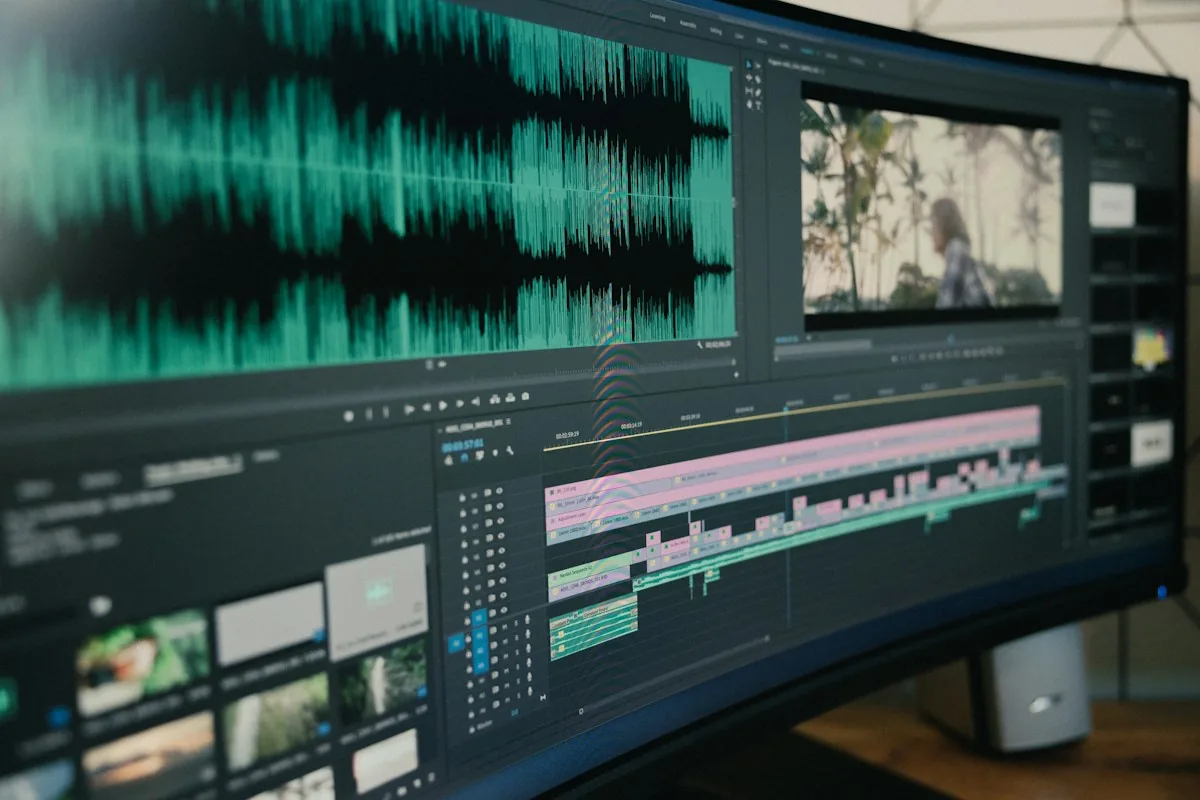
Screeners
Meet Jamal. He’s a New Orleans documentary filmmaker who spent three years on a 94-minute film about the last family-owned shrimp boat in Plaquemines Parish. This fall, he submitted it to festivals through FilmFreeway, the way they require. And then the emails started pouring in. A sales agent in Los Angeles saw the trailer. A programmer from a regional festival asked for a link after a pitch. A local journalist wanted to write about the film before the premiere.
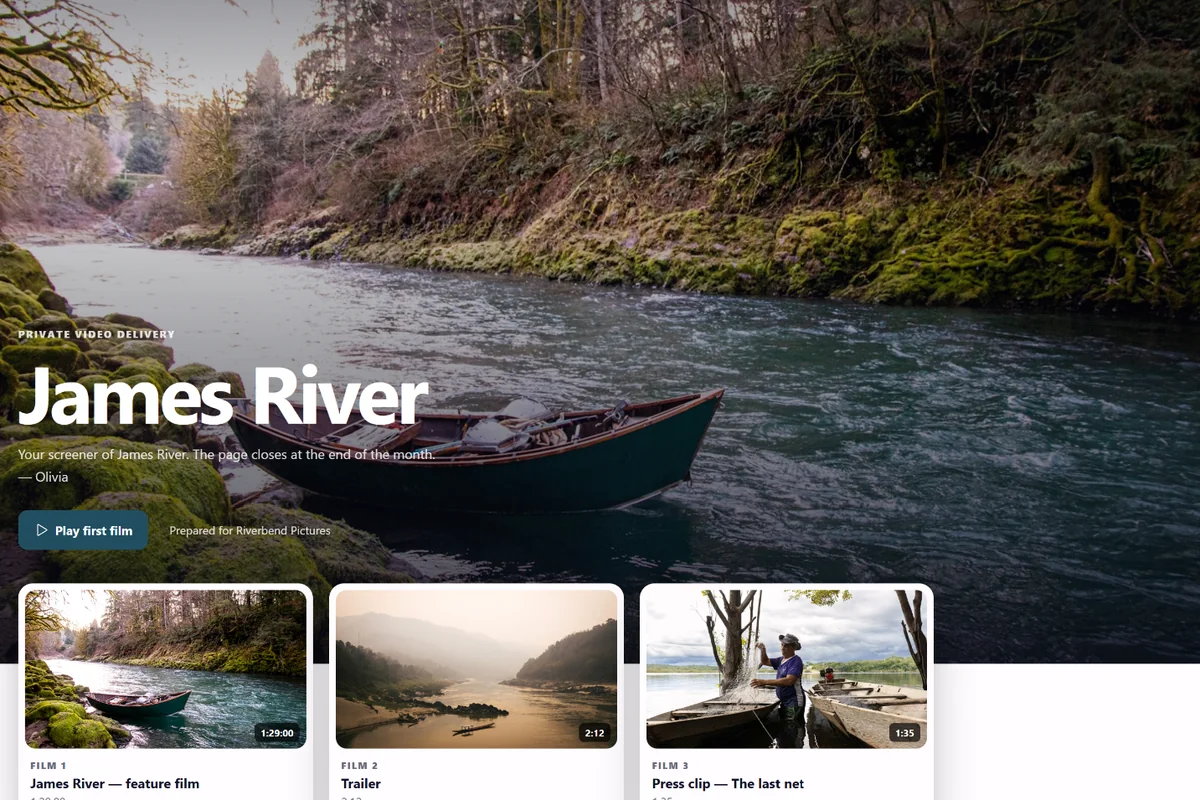
Jamal sends each of them a separate delivery page: its own password, its own expiry date, and downloads turned off. The film opens in the browser in a second, with no sign-up and no multi-gigabyte file. When the viewing window ends, the link closes on its own, and if you unpublish the page, even a player that’s already open stops within about a minute.
One link for everyone isn’t a screener. It’s a release you don’t know about.
For the finished image
From a 4K master, VodSpot builds an adaptive 2160p, 1080p, and 480p stream. Smaller sources are never upscaled.
Up to 20 SRT or WebVTT tracks per film — English, English SDH, French for the buyer in Montréal.
When downloads are enabled, the recipient gets your export byte for byte, with its original file name.
Upload a still or pick one right in the player with “Pick a frame.”
Embed on your own site with no ads and no suggested videos, only on your domains.
Opens, views, and downloads for every page; on Pro, completion and watch time.
Use cases
For programmers who write to you directly, not through a submission platform.
Sales agents and buyers each get their own page and their own stats.
A link that lasts until the embargo lifts or the vote closes.
Finished work for the client on a branded page, with the master.
Video hosting for filmmakers, explained
Video hosting for filmmakers is where a film lives before and after its premiere: privately, in full quality, and with an answer to the question “who saw it?”
It sounds simple until you count how many people need to see the film before the audience does. For Jamal, it’s eleven people in the first month: agents, programmers who asked him for a link directly, journalists, a co-producer, and his mother in Baton Rouge. Each one has their own deadline and their own level of trust.
Submitting to a festival is a separate job with its own tools. FilmFreeway does that job honestly: “By default, only you and festivals you submit to can view your projects.” But that link lives inside FilmFreeway. You can’t send it to a sales agent in Los Angeles, and emails like that are exactly what video hosting for filmmakers is for.
So Jamal keeps the film on VodSpot, like a house with many doors. One project, eleven delivery pages. The agent gets a password and 30 days. The journalist gets access until the embargo date. Mom gets no expiry at all, plus a download button, because she’ll ask for one anyway. Each page can have its own language and one of five layouts, and each can be unpublished without touching the others. To set this up step by step, read the guide on how to share videos privately with clients.
You have one film. It needs as many doors as there are people.
Let’s be honest up front: video hosting for filmmakers doesn’t replace a submission platform. Sundance says it plainly in its 2026 guidelines: all projects “must be delivered as online screeners on your FilmFreeway project page,” as an upload or a Vimeo or YouTube link. And to be perfectly clear: “We do not accept links for video or file hosting platforms other than Vimeo and YouTube.” You can’t put a VodSpot link in a Sundance submission, and we won’t pretend you can.
But look at Sundance’s numbers. In December 2025, the Sundance Institute reported 16,201 submissions from 164 countries for the 2026 festival, 4,255 of them features. Ninety features were selected, roughly two in a hundred by our math. Most of a film’s life happens not in that window but after it: at smaller festivals, with agents and buyers, in the press. And there, people usually ask you for a link directly.
That’s where quality starts to matter. FilmFreeway accepts files up to 20 GB and recompresses them to a “maximum video height of 1080 pixels.” That’s enough for selection. A buyer deciding on TV rights gets to see the 4K version, and when the deal closes, you hand over a master of up to 50 GB (up to 100 GB on Studio) with one click. If the buyer still wants the file on a drive, see how to send a large video file.
FilmFreeway gets your film to the festival. Everything else, you send yourself.
The most expensive click in the life of an independent film is “Public.” Many festivals treat a film that was ever publicly available as already shown.
Berlinale is strict about this: films “must not have previously been presented online or as VOD,” and a film that has been online “is no longer eligible.” There’s exactly one exception: “Sole exceptions are personal, password-restricted links, which were created for a festival submission process.” A personal link with a password: yes. A public video, even for a day: no. Sundance, too, rules out features that were available to the public “for free or for purchase,” online included.
How common is this? In November 2025, industry analyst Stephen Follows published an analysis of the rules of 10,549 festivals. Only 11.1% reject films that have already been online outright, 16% explicitly accept them, and 72.8% don’t say. The strictest rules apply to features. His conclusion is short: “A password-protected Vimeo link is acceptable; a public YouTube release is not.”
So here’s the simple rule for video hosting for filmmakers: no “anyone with the link can watch.” On Vimeo, Unlisted simply means the video “will not appear in public search results,” and anyone with the address can still open it. On VodSpot, videos are private from the moment you upload them, the delivery page is hidden from search engines and can’t be embedded on other sites, and a link preview for a protected page in a messaging app shows neither the title nor the poster, only “Private delivery from” and your name. For how to pick a password that won’t end up in a group chat, see the video password guide. And read each festival’s rules before you send the first link.
You only get one premiere. Don’t waste it on a link you forgot to close.
Every recipient plays a different role, so video hosting for filmmakers should give each one a page set up for it.
Sales agents: email sign-in. A password gets forwarded in a single line. Email sign-in doesn’t: the viewer enters their address and a six-digit code from the email, and you see who opened the page. That’s on Pro, with up to 400 viewers per workspace.
Buyers: watch time. When Jamal’s agent showed the film to a distributor, Jamal found out from the first-open email. A week later, the analytics showed him something more telling than any “viewed”: average completion on that page was 96%. People watched all the way to the credits. On Pro, every page shows completion and watch time.
Press: an expiry date set to the embargo. The link expires on the day the review can run, or on premiere day. VodSpot emails you three days before the expiry date, so you can extend it or let it close.
Juries: subtitles and chapters. A juror from France turns on French subtitles and jumps back to the water scene using the chapters on the timeline. The player remembers where each viewer left off.
When a leak would be costly: a name on the frame. On Studio, the viewer’s email floats semi-transparently across the frame, even in full screen. It isn’t DRM: anyone can film the screen with a phone, and no hosting service can stop that. But the recording will carry their email. To see how different watermarks work, read what is a video watermark.
What VodSpot doesn’t do: frame-accurate comments on a rough cut (that’s what Frame.io is for), DRM, or a ZIP of every file on a page. A screener doesn’t need them.
A screener isn’t a file. It’s a conversation, and you can see where the other party stopped watching.
A film sells itself once. The reel sells you. The US Bureau of Labor Statistics (BLS) counted about 181,000 producer and director jobs in 2025, and 20% of those people were self-employed. The median pay was $90,360 a year in May 2025. One in five has to find the next project on their own, and the first place a client looks is their website.
That’s why video hosting for filmmakers is also a player for your portfolio. On VodSpot, it has no ads, no suggested videos at the end, and no third-party trackers. The embed code loads lazily, so it doesn’t slow your page down. Allow up to 25 domains (your website, your Squarespace portfolio, your film’s page), and copied code simply won’t play on anyone else’s site. On Pro, analytics show where the player is embedded (“Embedded on”). More on the video embeds page.
How much does video hosting for filmmakers cost? Jamal uses Pro: $59 a month or $590 a year, which is $118 (17%) less than twelve monthly payments. 500 GB holds the master, trailers, a reel, and an archive of past work, and there are no fees for views: however many times the agent shows the film to buyers, the bill stays the same. If you don’t need email sign-in, Solo covers a single filmmaker: $24 a month, 150 GB. You can try it free for 7 days, no credit card required. To see where festivals themselves host video, read video hosting for festivals; if you teach or study film, see hosting for film schools. All plans are on the pricing page.
Your film has already told its story. Let your site tell who made it.
FAQ
If the festival accepts submissions through FilmFreeway, submit there. For everyone who asks you directly—programmers, agents, buyers, press—video hosting services like VodSpot give each one their own page with its own password, expiry date, and downloads off. You get an email the first time it’s opened, and you unpublish the page when the viewing window closes.
Yes. Upload up to 20 SRT or WebVTT tracks per film—for example, English, English SDH, and French. Viewers select the language in the player, and you choose the default track.
Yes, in an ad-free player with no suggested videos that plays only on your domains—up to 25 on any plan. Learn more on the video embeds page.
The stream is a set of adaptive renditions up to 4K, so the film plays smoothly on any connection. When the quality must be exact, allow downloads, and the recipient gets your untouched master with its original file name.
No platform can fully block screen recording. But you can sign every copy: email sign-in (Pro) shows who opened the page, and on Studio, the viewer’s email or your own text floats across the frame. A recording shows whose copy it was.
No. Sundance only accepts screeners on your FilmFreeway project page, as an upload or a Vimeo or YouTube link. VodSpot’s video hosting for filmmakers is for screeners you send directly to people: programmers, sales agents, buyers, press, and juries.
A personal, password-protected link usually won’t. Berlinale explicitly exempts “personal, password-restricted links,” and Stephen Follows, after studying the rules of 10,549 festivals, notes that a password-protected Vimeo link is acceptable, while a public YouTube release is not. Rules vary, so read each festival’s—and never make the film public before its premiere.
Solo is enough to start: $24 a month, 150 GB, passwords, expiry dates, and a separate page for each recipient. Pro, at $59 a month, adds email sign-in, completion for each page, your own domain, and 500 GB. Studio adds a viewer email watermark and country restrictions for territorial rights. See pricing.
Guides
Events
A festival’s video life starts months before the first show and continues long after the last one. Here is how to host it at every stage.
Read the guidePrivate sharing
Choose the right access controls, package the viewing experience, and test every client path before you send the link.
Read the guideVideo security
Passwords are one useful layer. Good private delivery also depends on expiry, revocation, clear communication, and sensible recipient access.
Read the guideFor filmmakers
Start with seven days and 5 GB. No credit card required.