Article embeds
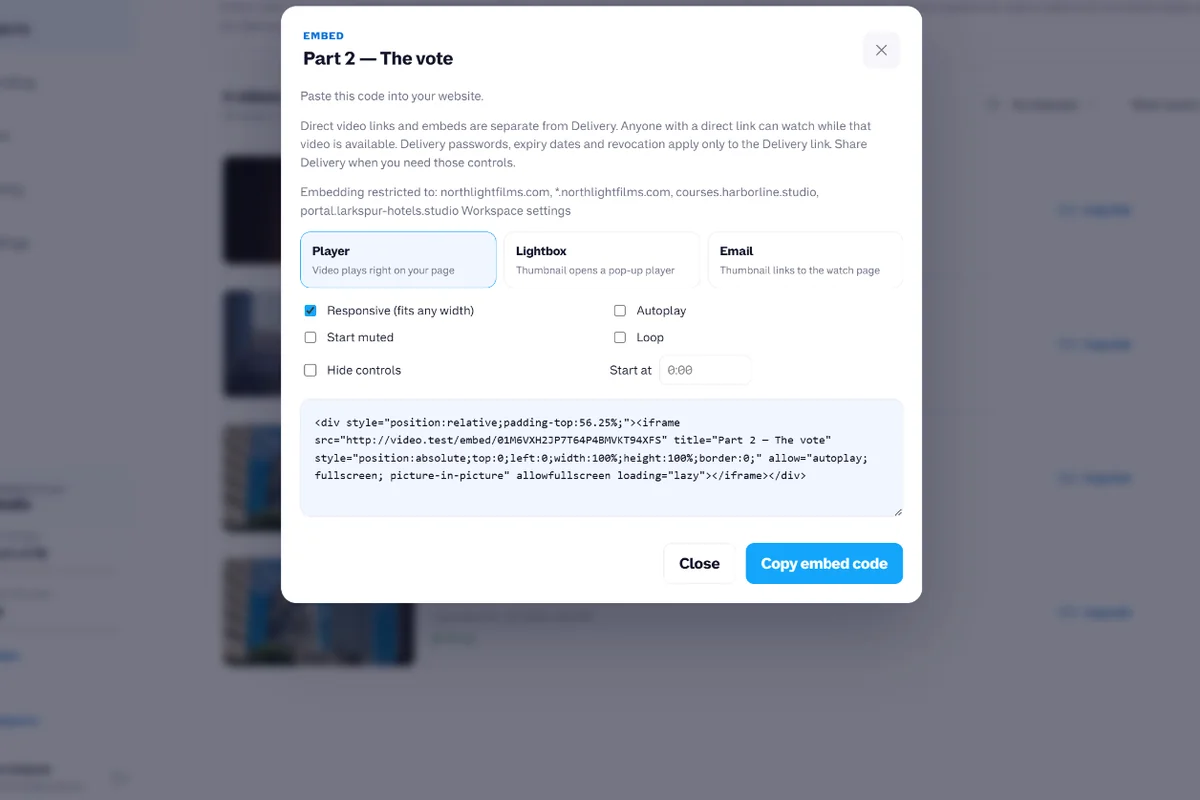
A player with no platform logo, no ads, and no related videos. Embed code that loads lazily.
Video hosting for publishers
Video hosting for publishers means a player that belongs to you. No ads, no one else’s recommendations, no third-party trackers, and it plays only on your domains. The video in your article loads lazily and never holds up the text, while raw and embargoed footage goes to partners on their own pages—each with its own password, an expiry date, and an email to you when it’s opened.
✓ 7-day free trial 5 GB included No credit card

Use cases
One interview lives several lives in a newsroom: a rough cut for the lawyer, a package for a partner under embargo, a video in the article, an archive entry a year later. Video hosting for publishers keeps them all in one project. Only one thing changes: who can watch, and until when. One video, four audiences, zero re-uploads.
A player with no platform logo, no ads, and no related videos. Embed code that loads lazily.
A page per partner: a password or email sign-in, an expiry date, and an email to you on first open.
The full recording, with chapters to jump directly to the quote and up to 20 caption tracks (SRT or VTT).
Exact originals for partner outlets, with the original file name and an email to you on every download.
One project per story: raw footage, the cut, and every partner page stay together and are easy to find a year later.
Views, completions, watch time, and the sites where the player is embedded (detailed analytics on Pro and higher).
Keep readers on your site
Owen is the video editor at a regional news site in Philadelphia. His videos—four minutes for an investigation, ninety seconds for a city council story—live inside the articles. And the article page is heavy enough without video: ad scripts, analytics tags, a newsletter pop-up.
The Financial Times knows what every extra second costs. In 2016, FT engineers Matt Chadburn and Gadi Lahav randomly split FT.com subscribers into groups and deliberately slowed the site for some of them. A one-second delay cut the number of articles read by 4.9% over seven days; a three-second delay, by 7.2%. Readers didn’t complain. They just read less.
That’s why video hosting for publishers at VodSpot starts with the embed code. It includes loading="lazy": the browser doesn’t load the player until the reader scrolls to it. The lightbox option is lighter still: the article shows only a preview image with a ▶ button, and the player opens over the text on click. Quality adapts to the reader’s connection, and the player plays only on the domains on your list—up to 25 on any plan.
Readers came for the story. The video should wait for them, not hold them up.
Video hosting for publishers, explained
Video hosting for publishers is hosting where a newsroom’s videos live on its own pages: in its own player, with no platform ads and no recommendations that lead readers off to other outlets’ stories. And where the same videos have a private life too—for lawyers, partners, and the archive.
The Reuters Institute for the Study of Journalism at the University of Oxford shows why this matters now in its report “Journalism, Media and Technology Trends and Predictions 2026.” Nic Newman surveyed 280 news executives from 51 countries at the end of 2025. They expect search traffic to their websites to fall by more than 40% within three years. And they’re answering with video: the share who think it’s important to invest more in video is 79 points higher than the share who think the opposite. Their top outside platform is YouTube, with a net score of +74.
Owen’s newsroom lives exactly this. The managing editor came back from a planning meeting with two words: “more video.” Owen cuts a one-minute version of every story for YouTube, where people will find it. The full version goes into the article, in the newsroom’s own player: there, readers watch to the end, keep scrolling, and maybe subscribe.
This kind of hosting is easy to spot. Watch the last second of the video. If the player suggests someone else’s videos, it works for the platform. If it shows your next story, or nothing at all, it works for you.
YouTube brings people in. Your page is what keeps them.
Embedding a YouTube video is the fastest route, but it carries a price you don’t see right away. YouTube’s help page puts it bluntly: “Only YouTube and the video owner will earn revenue from ads on embedded videos.” If the video is yours and monetized, YouTube ads run inside your article, and you can’t turn them off for embeds only—the help page admits there’s no such switch. If the video isn’t yours, you earn nothing from those ads.
On top of that, every such player is one more outside company on a page that already has plenty. In 2018, Timothy Libert and Rasmus Kleis Nielsen of the Reuters Institute examined news sites in seven EU countries, from Finland to Spain. An average news page called on 17 third-party domains serving advertising and marketing content, while a page on a popular non-news site called on just four. The reader doesn’t see this, but their browser does.
Video hosting for publishers at VodSpot doesn’t add anyone to that chain. The player has no ads, no third-party trackers, and no related videos, and we don’t store viewers’ IP addresses. At the end of the video there’s no feed of other outlets’ stories, just your own button: “Read part two” or “Get the newsletter” (the call to action and end screen come with Pro and higher). Owen points his to the next part of the investigation. How restricting the player to your domains works, and why that alone isn’t enough, is covered in how to embed a private video on a website.
Embed someone else’s player, and you hand them the ending of your story.
Newsrooms know embargoes from the receiving end. EurekAlert!, the science news service run by the American Association for the Advancement of Science (AAAS), requires reporters not to publish material before the embargo lifts and not to share their login, password, or the material itself with anyone. Under the agreement on the EurekAlert! site as of November 2026, a breach can get access suspended not just for the person who leaked but for everyone employed by their news organization. One mistake, and the whole newsroom loses its press releases.
When you’re the one setting the embargo, you need the same discipline. Owen’s investigation goes live Thursday at 6 a.m. at three partners at once: a TV station, a public radio station, and a nonprofit statewide newsroom. On Monday, each partner gets its own delivery page: a password, or email sign-in limited to a list of addresses (Pro and higher), the embargo lift time in the message, and an expiry date one week after publication. The TV station can download the exact originals to cut its own version; the radio station can only watch. Owen gets an email the first time each partner opens its page, and again on every download.
On the Studio plan, the viewer’s verified email appears over the picture. We don’t have DRM, and a screen can always be recorded, but that recording carries the email of whoever made it. Downloaded originals aren’t watermarked, so turn on downloads only for the partners who need the file. For more on watermarks and when they work, see what is a video watermark.
If something goes wrong, you unpublish that one page with a single click: the link stops working at once, open players stop within about a minute, and the other two partners never notice.
An embargo holds when every copy has a name on it.
Before you hand your newsroom’s video to a service, ask it eight questions:
The big media platforms are built around advertising, and their prices come on request. Brightcove: “Contact our sales team for a personalized quote and demo.” JWX (formerly JW Player): “Contact us to get started today.” If your video business runs on ads, these are powerful tools.
If you need ad-free editorial video, VodSpot’s video hosting for publishers earns its price. Pro is $59 a month or $590 a year—$118 (17%) less than paying monthly—with 500 GB, three seats, a custom domain for the player and pages, and detailed analytics with CSV export. That covers Owen’s three-person video desk. For bigger newsrooms, Studio is $149 a month: 1.5 TB, ten seats, a watermark with the viewer’s email, country restrictions for licensed footage, and an activity log. Extra storage comes in 250 GB blocks for $25 a month. There’s no bandwidth fee. Details are on the pricing page.
Pay for what you store, not for the day everyone reads your story.
FAQ
The one where the player works for you and your footage has a private side. Video hosting for publishers from VodSpot does both: an ad-free, tracker-free player for articles, and separate pages for partners with a password, an expiry date, and exact originals. It doesn’t do ads or live streams.
Yes. Any CMS that accepts an iframe—WordPress, Ghost, or your own system—will display the VodSpot player: responsive, fixed-width, or lightbox. There are no CMS plugins and no public API.
Create a separate delivery page for each partner: a password or email sign-in (Pro and higher), the embargo time in the message, an expiry date, and downloads only for those who need the file. You get an email the first time a page is opened and on every download, and on Studio the viewer’s email appears over the video.
No. VodSpot has no ad system. If video ads are your main source of revenue, consider Brightcove or JWX, and use VodSpot for private work.
Both, for different jobs. The short version on YouTube brings in new viewers. The full version in the article, in your own player, keeps them with you: no YouTube ads and no related videos at the end.
It can: in 2016, the Financial Times found that a one-second delay cut the number of articles read by 4.9%. The VodSpot embed code loads lazily (loading="lazy"), only when the reader scrolls to the player, and the lightbox option puts a single image on the page until someone clicks Play.
Yes. Add up to 25 of your domains to the allowed domains list—on any plan, including the trial. The player won’t open on other sites. To pull the video from every site at once, use Regenerate link: old codes stop working, and open players stop within about a minute.
No. Plans are priced by storage, not views: Pro includes 500 GB, and you can upload up to half that each month. A viral video doesn’t turn into a bill.
Guides
Publishers
Editorial video has two lives: the finished story readers see and the private footage behind it. Here is how to host both without handing your audience to someone else.
Read the guideSports
Highlights want reach, full matches want structure and analysis footage wants privacy. Here is how clubs and sports media can host all three.
Read the guideEmbeds
Unlisted isn’t private, and hiding a video URL isn’t security. Here is how to put a video on your site so it only plays where — and for whom — you intend.
Read the guideFor publishers
Start with seven days and 5 GB. No credit card required.