Client delivery
Best Video Delivery Platforms in 2026
The best video delivery platforms for videographers, studios and agencies: 10 tools compared on client experience, original files, link lifetime, branding and real yearly cost.
Read the guideA VidFlow alternative
VidFlow is a polished service for wedding galleries. But its terms run on a calendar: originals are kept for a year, the gallery for two, and then it’s “permanently deleted.” VodSpot is a VidFlow alternative that works on your terms: the exact original stays as long as your subscription is active, and the link lives until you switch it off. And this video hosting for videographers charges for storage, not for every gigabyte you upload.
✓ 7-day free trial 5 GB included No credit card
VodSpot vs. VidFlow
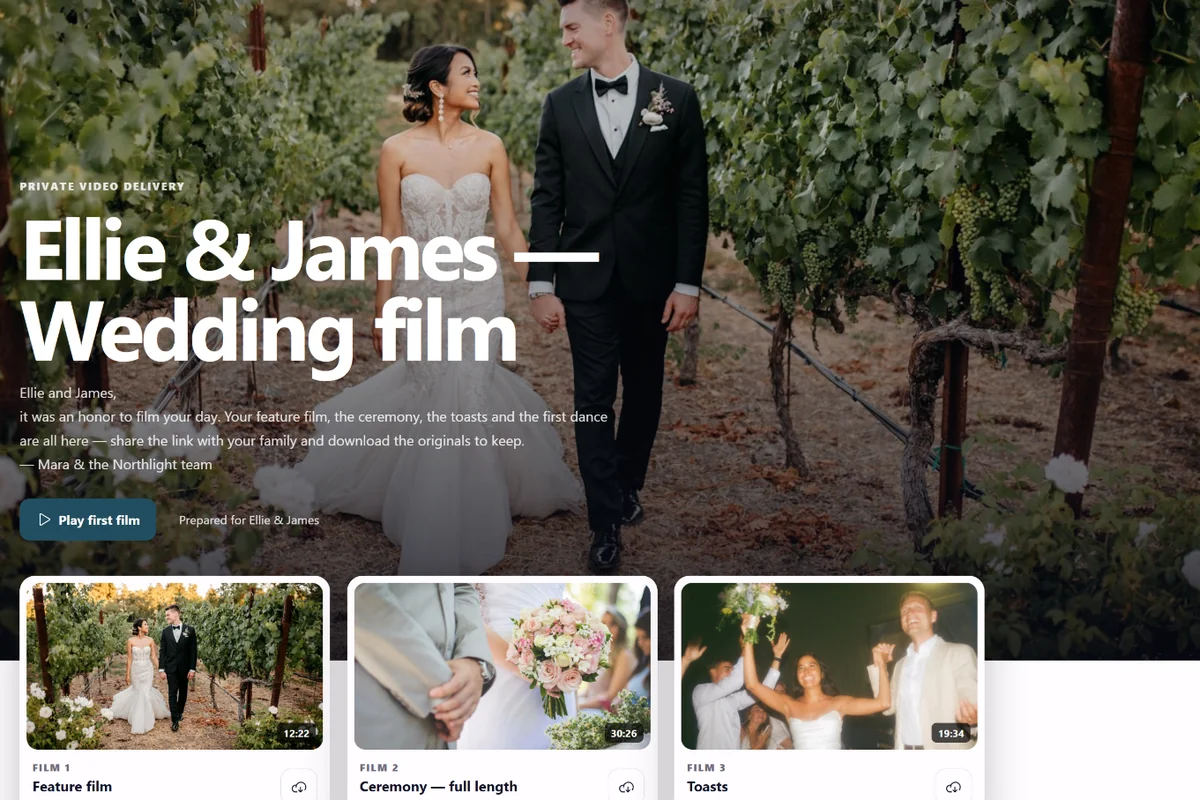
Meet Ben, a wedding videographer from Sacramento. He shoots three or four weddings a month in summer and two a month in winter, and VidFlow’s packs suit that schedule: buy 100 GB in February and forget about a subscription. It all worked fine until one couple, 14 months after their June wedding, asked for the original of the full ceremony for the bride’s parents. That’s when Ben started looking for a VidFlow alternative. Here’s why.
A great gallery service. But a gallery isn’t an archive.
| VodSpot | VidFlow | |
|---|---|---|
| Payment model | Monthly or annual subscription (a year costs 10 months) | One-time Upload Packs (valid for a year) or an annual membership paid a year in advance |
| What you pay for | Storage: how much you keep right now | Upload quota: how much you upload per pack or per year |
| Entry plan | Solo — $24/month, 150 GB of storage | 50 GB Upload Pack — $60; Plus — $19/month billed annually, 35 GB of uploads a year |
| Mid tier | Pro — $59/month or $590/year, 500 GB, custom domain, 3 seats | 500 GB Upload Pack — $475; Pro — $79/month billed annually, 1 TB of uploads a year |
| Originals | Kept as long as your subscription is active | 1 year from project creation, then only processed versions |
| Client access | Until you unpublish the page or until an expiry date you set | 2 years from gallery creation (the client can extend), then “permanently deleted” |
| If you stop paying | 14 days read-only with links paused—time to download your originals or renew; then deleted | Galleries live out their 2 years; after you close your account, you have 30 days to access content |
| Revisions | A new version is a regular upload within your monthly upload allowance, no per-gigabyte charge | Free for 10 days after upload (60 days on annual plans), then new quota |
| What the client downloads | The exact original with its original file name | Original (first year) and a compressed Mobile-Friendly version |
| Client page languages | 6, set per page | 9, picked automatically by browser language |
| Photos in the same gallery | —No | ✓Yes |
| Gallery mobile apps | —No | ✓ annual membership |
| Free trial | 7 days, 5 GB, no card required | 10 GB of free quota for new users |
Prices and terms checked November 2, 2026, on VidFlow’s official pricing, help, and Terms of Service pages.
A year of Ben’s work: about 100 GB of new footage a month, 1.2 TB a year.
Total $1,170 a year
Total $590 a year
$580 less (−50%)
VidFlow and a VidFlow alternative like VodSpot run on different models. VidFlow charges for uploads and keeps the gallery for two years with no further payments; VodSpot charges for storage and keeps everything as long as you pay. Pro holds 500 GB at a time—roughly Ben’s last five months of work—as long as he deletes projects couples have already downloaded. To keep the whole year online, Pro plus three 250 GB storage add-ons comes to $1,340, $170 (+15%) more than VidFlow, but the originals don’t disappear after a year. An annual VidFlow Pro membership ($948 for 1 TB) plus two 100 GB packs comes to $1,168, almost the same. VodSpot Pro billed monthly is $708, $462 (−39%) less than the packs. A revision after day 10 on VidFlow eats new quota: a 20 GB 4K master costs about $24 at the 50 GB pack’s rate. Prices checked November 2, 2026, excluding tax. Pay for what you keep, not for every upload.
Source files
Back to Ben. The wedding was in June, and the couple’s email came the following August: the bride’s parents want to show the full ceremony on the big screen at their anniversary. Not a phone video—the original. Ben opens the VidFlow gallery, and it holds only web versions. It’s right there in the Terms of Service, section 2.4: originals are kept for one year from the project’s creation, “Clients must download source files within this timeframe,” and after that “only the processed versions remain available for download.” The couple never got around to it. Honeymoon, a move—life happened.
Fine, Ben thinks, there’s always the archive. He plugs in the drive from that season—and it won’t mount.
That’s not bad luck. That’s statistics. In 2007, Eduardo Pinheiro, Wolf-Dietrich Weber, and Luiz André Barroso of Google studied more than 100,000 drives in the company’s data centers: the annual failure rate rose from 1.7% for drives in their first year to more than 8.6% for three-year-old drives. And more than 56% of the failed drives showed none of the four main SMART warning signs. A drive doesn’t warn you. One day it just won’t connect.
So the file on your delivery page isn’t just a convenience—it’s a second copy, and a VidFlow alternative should keep it well past the honeymoon. In VodSpot, the exact original—the very file you exported, with its original name—is never re-encoded and stays as long as your subscription is active: one, three, five years later. When a couple downloads it, you get an email. We covered why a cloud folder handles this job worse in video hosting vs. cloud storage.
A web copy is for watching. The original is for keeping.
Link lifespan
Links die faster than you think—even where the law depends on them. In 2014, Jonathan Zittrain, Kendra Albert, and Lawrence Lessig of Harvard checked the links cited in Harvard law journals and US Supreme Court opinions. In the journals, more than 70% of them no longer led to the cited material. In Supreme Court opinions, the figure was 49.9%.
How fast does it happen? Wallace Koehler of Valdosta State University collected 361 random web pages in December 1996 and kept checking them for years. By May 2003, only a third of the sample—33.8%—was still there. In his 2004 paper in Information Research, he put the half-life of a random web page at about two years.
Two years is exactly how long VidFlow’s client access lasts: “Every gallery delivery includes 2 years of access for your clients.” Near the end, clients get an email offering to extend their gallery access; the service doesn’t name a price. Didn’t renew? Under section 2.3 of the terms, “the gallery and media are permanently deleted.” It’s a tidy system. But it builds an expiry date into every link.
A VidFlow alternative like VodSpot works the other way around: a delivery page has no built-in expiry date. You set one yourself when you need it: 30 days for an ad draft, “No expiry” for a wedding film. A reminder goes out three days before a page expires, and an expired page can be republished at the same link. Ben sets “No expiry” for weddings: the couple can open their film on their fifth anniversary, as long as Ben’s subscription is active. For setting up the whole delivery workflow, see video delivery workflow for freelancers.
A person should switch a link off—not a calendar.
Retention, honestly
Files often disappear not because of hardware, but because of policies. In 2008, Catherine Marshall of Microsoft Research summed up field studies of personal digital archives in D-Lib Magazine. About two-thirds of the reported losses came down to three causes: the service shut down, the owner didn’t know the provider’s policies, or the account was deactivated or lost. No disaster involved—just normal business practice.
So before you trust a service with your clients’ weddings, read its retention rules—VidFlow’s and those of any VidFlow alternative alike. VidFlow’s are above. Here are ours, without the fine print:
VidFlow is stronger here, and there’s no point hiding it: its galleries live out their two years even if you leave the service, and if you close your account yourself, the terms give you 30 days to access your content, against our 14. VodSpot keeps your work for as long as you subscribe, plus two weeks. Leaving the profession? VidFlow is more forgiving. Staying? VodSpot keeps your archive for as long as your business runs and won’t delete your 2026 wedding in 2028. For how delivery services compare on the lifetime of links and originals, see our best video delivery platforms review.
VidFlow’s retention follows a calendar. VodSpot’s follows your business.
There’s no rush: your VidFlow galleries keep running for their two years even after you move. Move one couple at a time, starting with the newest projects.
For the delivery process step by step, see client video delivery; for big files, see the videographers’ section of how to send large video files.
The best move is one with no deadline.
FAQ
Clients get two years of access from the day the gallery is created (under the old Credits model, it was 10 years). Near the end, the client can renew access to the gallery; if they don’t, VidFlow’s terms say the gallery and files are permanently deleted. A VidFlow alternative like VodSpot doesn’t put an expiry date on links: a page stays live while your subscription is active, until you unpublish it or set an expiry date yourself.
For one year. Under section 2.4 of the terms, original files are kept for one year from the project’s creation. The client must download them within that time; after that, only the processed versions remain. In VodSpot, the exact original stays as long as your subscription is active and downloads with its original file name.
Upload Packs: 50 GB for $60, 100 GB for $110, 500 GB for $475, each valid for a year; new users get 10 GB free. Annual memberships: Plus at $19/month (35 GB of uploads a year), Pro at $79/month (1 TB), Ultimate at $165/month (5 TB), paid a year in advance. VodSpot: Solo $24/month, Pro $59, Studio $149; a year costs the price of 10 months. Prices as of November 2, 2026.
Galleries live out their two years—VidFlow says client access continues “even if you discontinue using the service.” If you close your account yourself, the terms give you 30 days to access your content. VodSpot works differently: when your subscription ends, the workspace is read-only for 14 days and public links are paused—you can download your originals, or renew and get everything back. After that, projects, videos, and delivery pages are deleted; the account stays.
Yes. Near the end of the two years, clients get an email and can extend access right from the gallery; VidFlow’s help center doesn’t name a price (checked November 2, 2026). With VodSpot there’s nothing to renew: a link with no expiry date stays live as long as your subscription is active.
No. A page expires only if you set an expiry date, and files stay as long as your subscription is active. When the subscription ends, links are paused and the workspace is read-only for 14 days; renew within that time and everything comes back, otherwise the content is deleted. You get emails about it in advance.
Yes, six: English, German, Spanish, French, Italian, and Portuguese (Brazil). You pick the language for each delivery page, and it covers the buttons, the password screen, the sign-in code email, and the player. For relatives abroad, make a copy of the page in their language. VidFlow supports nine languages and picks one based on the browser.
Download the originals from galleries less than a year old; for older ones, use the masters from your archive. Create a VodSpot project for each couple, upload the files, and publish the delivery page. VidFlow galleries keep working for their two years, so you can move to a VidFlow alternative gradually.
No. VodSpot handles video only: 4K streaming, full originals, subtitles, and chapters. If you deliver photos and films in one gallery, VidFlow does that.
Guides
Client delivery
The best video delivery platforms for videographers, studios and agencies: 10 tools compared on client experience, original files, link lifetime, branding and real yearly cost.
Read the guideClient delivery
Email stops at 25 MB. Here is how to send large video files by email link, cloud, transfer services, iPhone and hosting — with limits, upload times and what keeps the original intact.
Read the guideClient delivery
A practical final-mile checklist from upload and quality control to delivery, follow-up, and access cleanup.
Read the guideKeep exploring
Start with seven days and 5 GB. No credit card required.